Elements
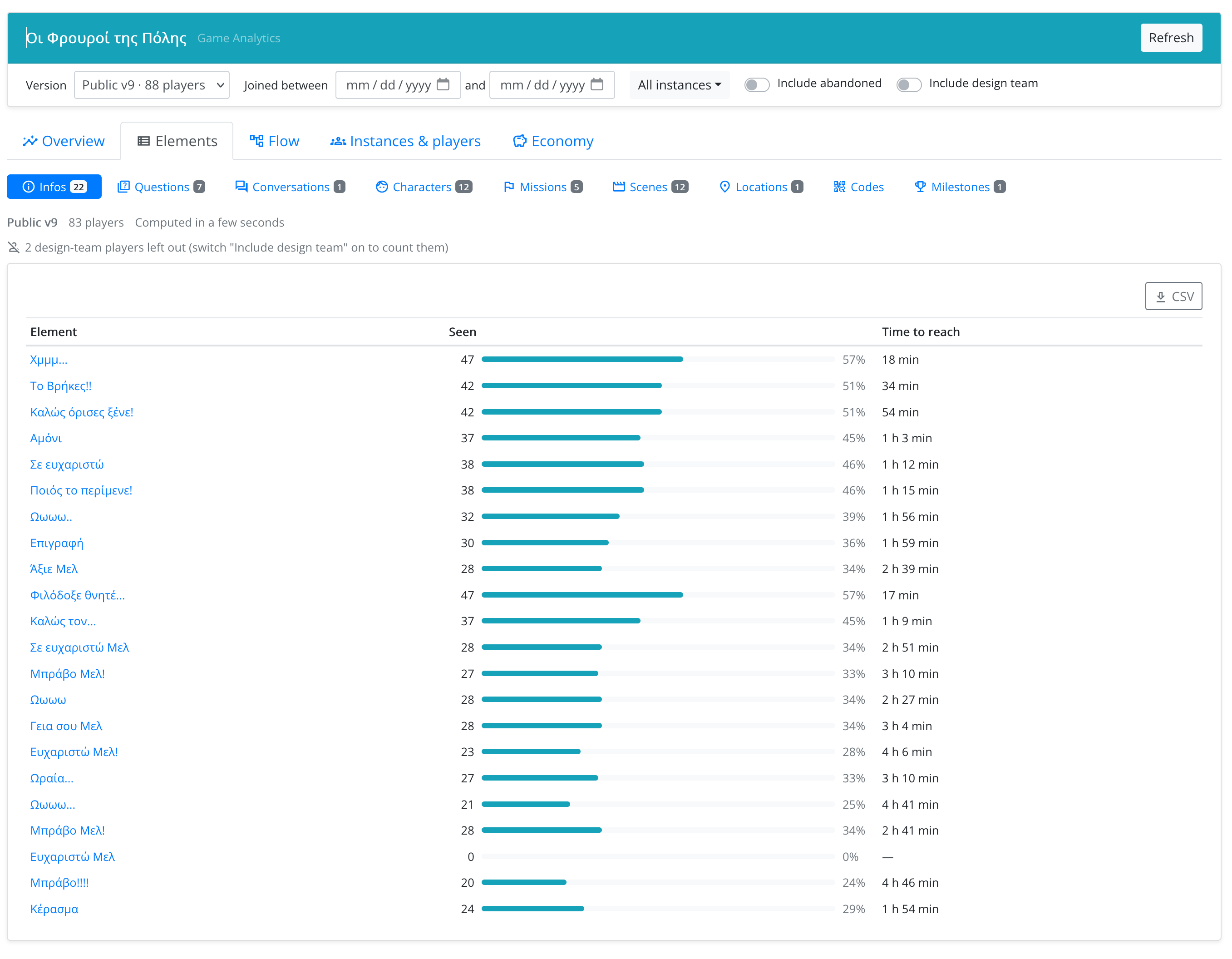
The Elements panel has one tab per element type your game uses: infos, confirmations, questions, quizzes, conversations, characters, missions, scenes, locations, codes, visual targets, physical tasks, external tasks, milestones and offers. Each tab is a table with one row per element.
The Tables
Every element goes through stages, and the table shows how many players reached each stage and what share that is. For example:
| Type | Stages |
|---|---|
| Info | Seen |
| Confirmation | Asked → Approved / Rejected |
| Question | Asked → Answered → Passed |
| Quiz | Asked → Started → Answered → Completed |
| Conversation | Started → Completed / Exited |
| Character | Talked to |
| Mission | Assigned → Completed |
| Scene | Entered → Exited |
| Location | Visited |
| Code | Read |
| Visual target | Scanned |
| Physical task | Started → Completed (or Failed, Canceled) |
| External task | Started → Completed → Passed |
| Milestone | Reached |
| Offer | Picked → Redeemed |
The table also shows the time to reach each element (from the player's first action in the game) and, where it applies, the time spent on it (e.g. from asked to answered). Sort by any column, e.g. to find the element most players never reached. CSV downloads the table.
Missions include their sub-missions, listed as "Parent › Sub". The Codes tab lists the codes players actually read.
Element Details
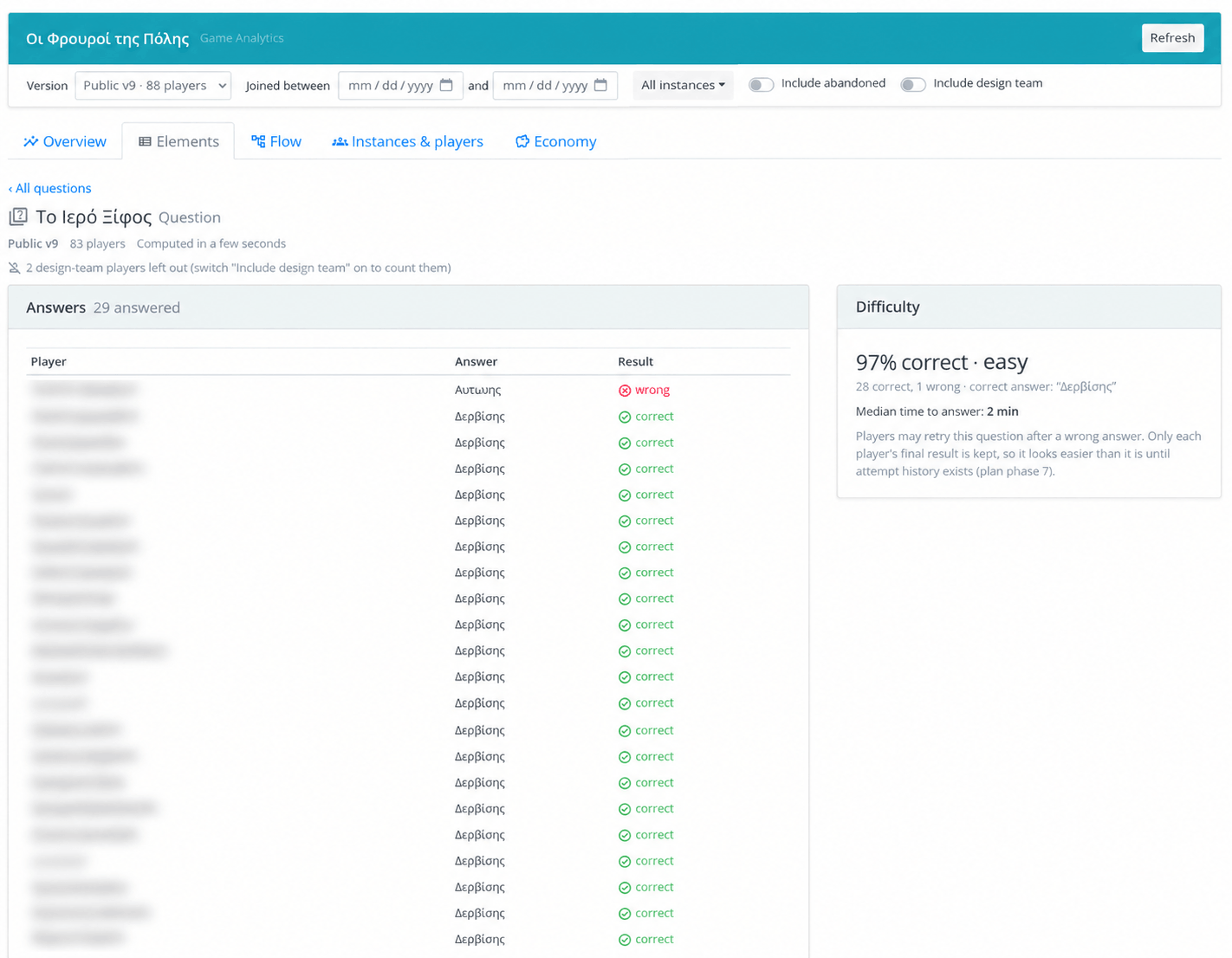
Click a row to open the element's detail: its funnel, the typical times, and the list of players who reached each stage, with when (downloadable as CSV). Most types add a report of their own:
| Type | The detail adds |
|---|---|
| Question | How many players chose each option, with the correct one marked; options nobody chose; free-text answers; the question's difficulty; the time taken to answer; who answered what. |
| Quiz | The distribution of scores; where players who did not finish stopped; a table of its questions with their difficulty and discrimination; the time to complete. |
| Confirmation | How many approved and rejected, and the time taken to decide. |
| Conversation | The conversation's flow, with the number of players who saw each statement and chose each option; statements nobody reached; where players left. |
| Mission | The time from assignment to completion; completions and rounds of repeating missions, and how many times players completed them; its sub-missions. |
| Scene | The time spent in the scene, and how many players stopped there. |
| Location | The time from the start of the game to the first visit, and a map of every location with its visit rate. |
| Info, code, visual target | The scene players found it in, and how long after entering that scene. |
| Physical task | Completion, and how far players got (as a share of the target). |
| External task | The time from start to completion, and how many passed. |
| Milestone | The scene where players reached it, and how long after starting the game. |
For what difficulty and discrimination mean, and how answers are counted, see Reading the Numbers.