Rollick Platform
Rollick Games platform (from now on just the platform or rollick) is an end-to-end solution that allows you to author, publish, manage, play, and monitor pervasive games without coding. It has been designed and developed by the Laboratory of Distributed Multimedia Information Systems (MUSIC) at the Electrical and Computer Engineering School of the Technical University of Crete and can be used by anyone for free. Rollick has been built in the context of the G4M Project (Game for Marketing) and was funded by the Region of Crete and the Greek National Framework Programme (ΕΣΠΑ) 2014-2020, an European Union co-funded development programme.
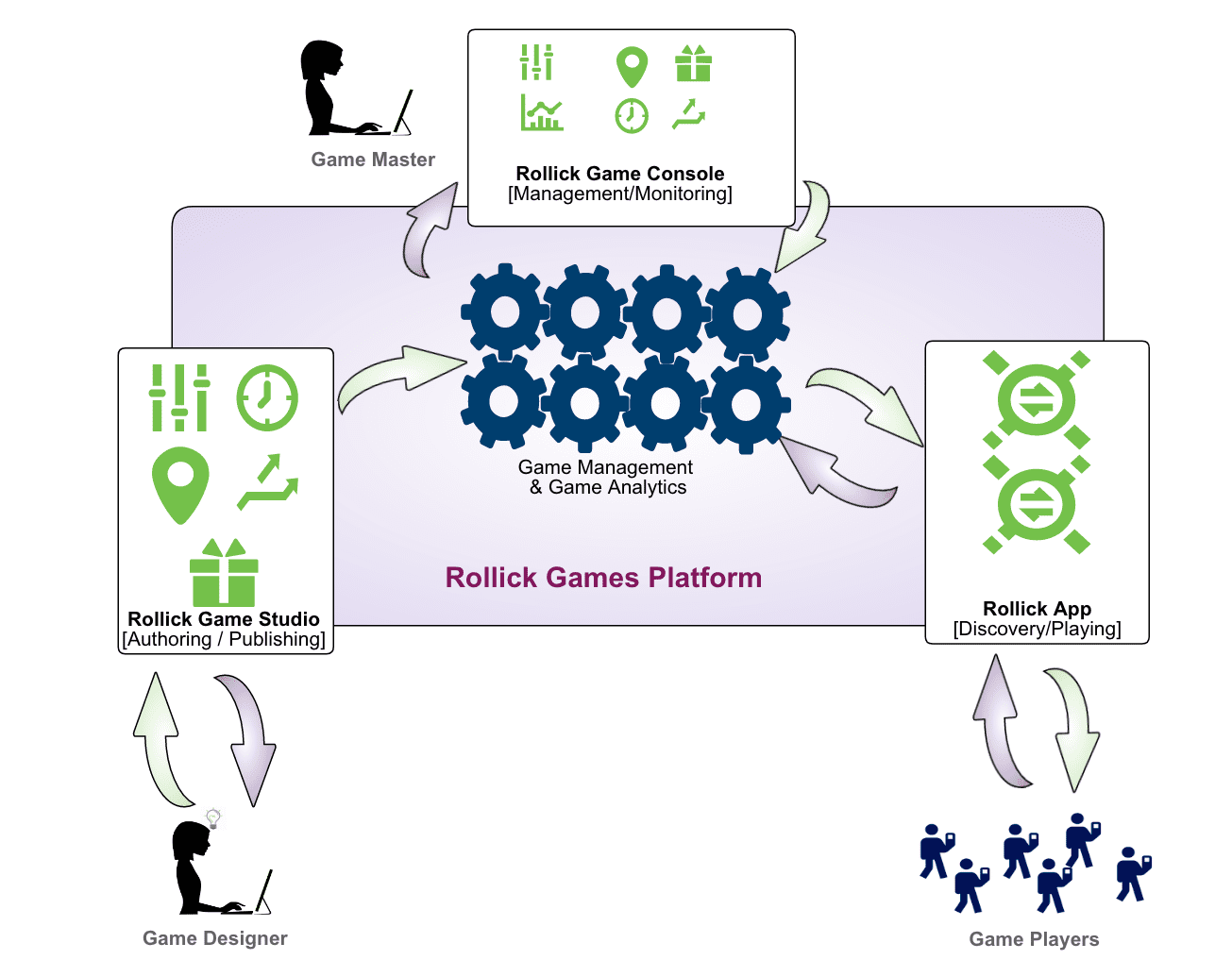
The entire rollick platform consists of
- The Rollick Game Studio. A Web application used to author and publish games
- The Rollick Player App. Mobile application (android & ios) used to discover and play games.
- The Rollick Game Master Console. Web app used to monitor and manage the game instances being played (see Game Master Console).
- Rollick Game Analytics. Web app used to analyse how players played a game (see Game Analytics).
- The Rollick Game Server. The backend infrastructure in which all related entities, (users, games, roles, media, stats, etc.) are stored and managed.
To provide a one-stop-shop solution, the Rollick Game Studio, the Game Master Console and Game Analytics are provided as one web application (https://rollick.tuc.gr (opens in a new tab)).
AI in Rollick
Rollick can use large language models ("AI") in three optional features, which your administrator enables per game:
- AI characters: characters that talk with players in their own words, inside conversations you design. The model talks; the game decides the outcome.
- Drafting with AI: a model writes first drafts of texts, quizzes, conversations, items, profiles and rules in the Studio, for you to review and save.
- AI review of the plot: a model reads the whole scenario and points out texts that contradict the rules, story problems, language and age fit.
All three share the game's AI settings: which provider and models are used, who pays, and the spending limits. Nothing is decided or saved by a model alone: a designer reviews every draft and finding, and in play, code checks every judgment of a model.